

If you’ve been told you have inflammation, you’re not alone.
Every day, patients come to SIE Medical struggling with symptoms such as fatigue, brain fog, digestive issues, joint discomfort, weight challenges, headaches, skin problems, or persistent health concerns that don’t seem to have a clear explanation.
Often, they are told that inflammation is the culprit.
While inflammation may indeed be present, there’s an important distinction that many people never hear:
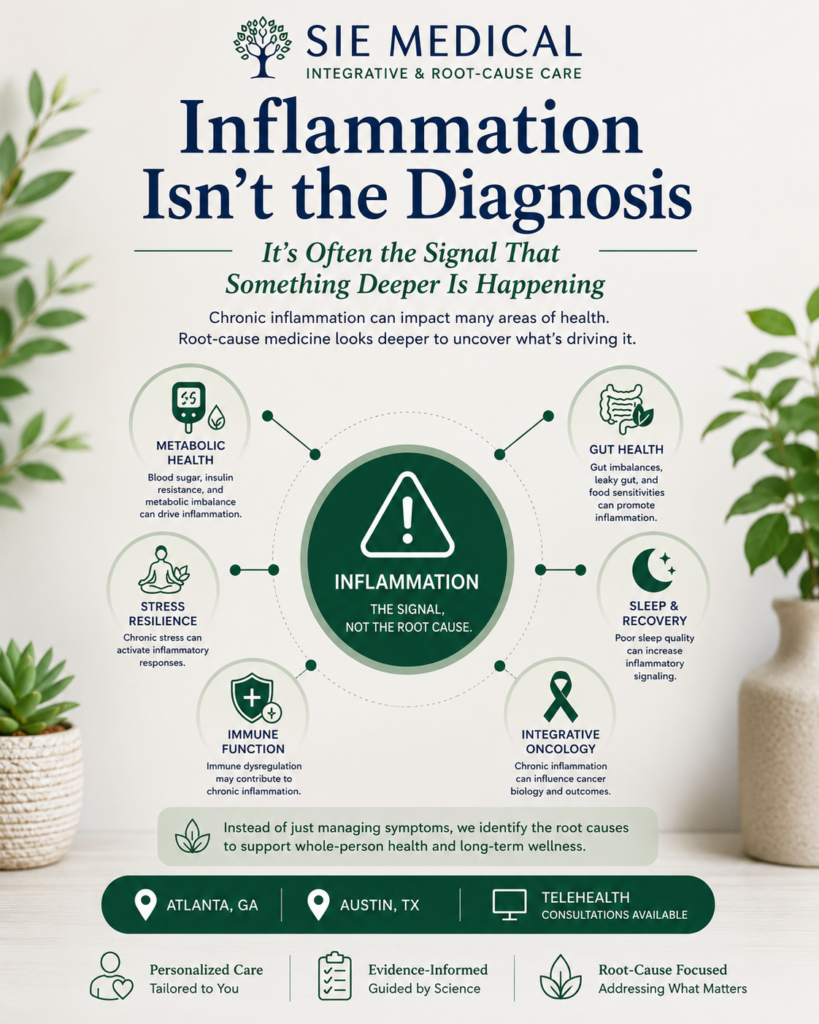
Inflammation is often not the diagnosis. It’s frequently the symptom.
Just as a fever can indicate an infection, inflammation can be the body’s signal that something deeper is happening beneath the surface.
The question isn’t simply:
“How do I reduce inflammation?”
The better question is:
“What’s causing it?”
At SIE Medical, we focus on identifying potential root causes contributing to inflammatory patterns through personalized, evidence-informed evaluation and care.
Whether you’re seeking care in Austin, Texas, or through telehealth consultations, understanding the drivers behind inflammation may be one of the most important steps toward improving long-term health.
Inflammation is a natural biological response designed to protect the body.
When you cut your finger, catch a virus, or experience an injury, inflammation helps coordinate healing and repair.
Short-term inflammation is often beneficial.
The problem occurs when inflammatory processes persist for months or years.
This is often referred to as chronic inflammation.
Research continues to explore links between chronic inflammation and:
However, chronic inflammation is rarely a standalone problem.
More often, it is the result of underlying imbalances that deserve investigation.
Imagine your home’s smoke detector goes off.
You could remove the batteries to stop the noise.
But that wouldn’t address the fire.
Inflammation works similarly.
Reducing inflammation without understanding what’s driving it may provide temporary relief while leaving underlying contributors unaddressed.
The goal should not simply be to silence the signal.
The goal should be to understand why the signal exists in the first place.
One of the most common yet overlooked contributors to inflammation is metabolic dysfunction.
Factors such as:
may contribute to inflammatory pathways throughout the body.
This is one reason metabolic health has become a major focus in modern preventive and integrative medicine.
The digestive system plays a critical role in immune regulation.
Issues such as:
may contribute to inflammatory signaling.
Because a significant portion of the immune system interacts closely with the gut, digestive health often deserves careful evaluation.
Stress is not just emotional.
It is biological.
Persistent stress may influence:
This is why stress resilience is an important component of whole-person care.
Sleep is one of the body’s most powerful recovery tools.
Insufficient or poor-quality sleep may contribute to:
Improving sleep quality is often an overlooked but important part of supporting overall wellness.
Modern life exposes individuals to numerous stressors including:
These factors may influence inflammatory pathways over time.
One of the biggest challenges with inflammation is that symptoms alone rarely tell the full story.
Two people may experience fatigue and elevated inflammatory markers while having completely different underlying contributors.
This is why personalized evaluation matters.
At SIE Medical, we believe data should guide decision-making whenever possible.
Testing may help evaluate factors related to:
Rather than guessing, testing may provide valuable insights that support more personalized recommendations.
Learn more:
https://siemedical.com/chronic-inflammation-symptoms-testing/
Researchers continue studying the relationship between chronic inflammation and cancer biology.
Inflammation may influence:
Importantly, inflammation alone does not cause cancer.
Cancer is a complex condition involving many factors.
However, understanding and addressing factors associated with chronic inflammation may be an important component of overall health and wellness.
Patients interested in whole-person supportive cancer care can learn more about our integrative oncology services:
Austin Integrative Oncology:
https://siemedical.com/austin/integrative-oncology/
Root-cause medicine focuses on asking deeper questions.
Instead of stopping at:
“You have inflammation.”
We ask:
This systems-based perspective helps create a more comprehensive understanding of health.
SIE Medical provides personalized integrative and functional medicine consultations for patients in:
📍 Austin, Texas
💻 Telehealth consultations for eligible patients
Our approach focuses on helping patients better understand the factors influencing their health through evidence-informed, root-cause evaluation.
Inflammation is often a signal—not the diagnosis.
The real opportunity lies in understanding what may be driving it.
Whether those contributors involve metabolic health, gut function, stress physiology, sleep quality, lifestyle factors, or other influences, identifying potential root causes may provide a more complete picture of health.
The goal is not simply to suppress symptoms.
The goal is to understand the story they are trying to tell.
Inflammation is a biological response. Chronic inflammation may be associated with various health conditions, but it is often considered a process rather than a standalone diagnosis.
Potential contributors include metabolic dysfunction, stress, poor sleep, gut health imbalances, lifestyle factors, and other underlying influences.
Testing may provide insights into metabolic health, inflammatory markers, nutritional status, hormone balance, digestive health, and other factors that may contribute to symptoms.
Research continues exploring links between chronic inflammation and various chronic health conditions, including metabolic, cardiovascular, autoimmune, and other concerns.
Yes. SIE Medical offers telehealth consultations for eligible patients in addition to in-person services in Austin, Texas and Atlanta, Georgia.