

One of the potential drivers of metabolic health is insulin resistance. Measuring and providing a plan to help reduce it, though diet, lifestyle changes and better metabolic processes, can positively impact your overall metabolic health as well as overall burden your body is carrying. as you can reduce your burden and increase your health your metabolism will thank you.
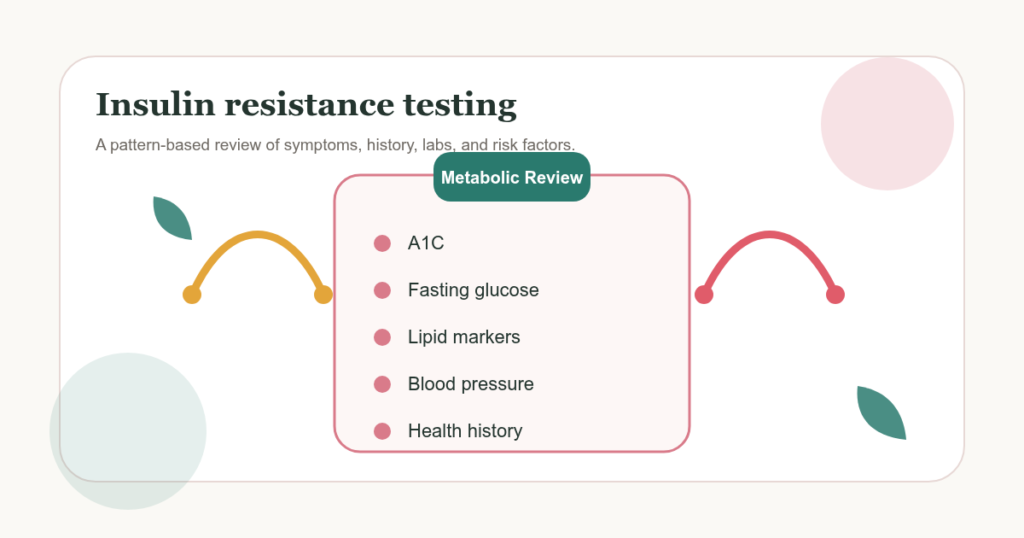
You usually cannot confirm insulin resistance by symptoms alone. A clinician may review your medical history, waist measurement, blood pressure, fasting glucose, A1C, lipid markers, and other risk factors to understand whether your metabolism is under strain.
Insulin resistance means cells in the muscles, fat, and liver do not respond to insulin as well as they should, which can contribute to higher blood glucose levels over time. NIDDK explains that prediabetes occurs when blood glucose is higher than normal but not high enough to be diagnosed as type 2 diabetes (NIDDK).
Insulin resistance can be silent, but patients often ask about it when they notice:
Cravings for sugar or carbohydrates
Post-meal fatigue or brain fog
Difficulty losing weight
Increased waist size
Fatigue despite rest
Skin changes or inflammation
A family history of type 2 diabetes or metabolic syndrome
Abnormal glucose, A1C, triglyceride, HDL cholesterol, or blood pressure readings
These patterns do not prove insulin resistance. They are a reason to ask whether metabolic testing, medical history, and risk-factor review would be appropriate.
Common tests and measurements that may help clarify metabolic risk include:
A1C: Shows average blood sugar pattern. NIDDK identifies A1C of 5.7% to 6.4% as a prediabetes range (NIDDK).
Fasting plasma glucose: Shows blood sugar after fasting. NIDDK identifies fasting plasma glucose of 100 to 125 mg/dL as a prediabetes range (NIDDK).
Oral glucose tolerance test: Shows blood sugar response after a glucose drink. NIDDK identifies 140 to 199 mg/dL on an oral glucose tolerance test as a prediabetes range (NIDDK).
Lipid panel: Reviews triglycerides, HDL cholesterol, LDL cholesterol, and related risk. High triglycerides and low HDL cholesterol are part of the metabolic syndrome risk pattern described by NHLBI (NHLBI).
Blood pressure: Helps evaluate cardiometabolic risk. High blood pressure is one of the core metabolic syndrome conditions described by NHLBI (NHLBI).
Waist measurement: Helps evaluate central adiposity. A large waistline is one of the metabolic syndrome conditions described by NHLBI (NHLBI).
Fasting insulin may be considered in some integrative or metabolic evaluations, but it should not be presented as a universal standalone diagnostic answer. NIDDK notes that health care professionals may not directly test for insulin resistance in routine care and that direct insulin resistance testing is primarily used for research studies (NIDDK).
Do my symptoms and family history suggest metabolic risk?
Are my A1C, fasting glucose, triglycerides, HDL cholesterol, waist measurement, and blood pressure optimal or concerning?
Should I be screened for prediabetes, metabolic syndrome, thyroid issues, sleep apnea, or hormone changes?
Could medications, sleep disruption, stress, menopause, or inflammation be contributing?
How often should my metabolic markers be rechecked?
At SIE Medical, insulin resistance questions can be viewed through a broader metabolic health model that includes blood sugar, inflammation, gut health, stress and sleep, hormones, circulation, immune function, environmental exposures, cognitive health, and epigenetics (SIE Medical). This approach helps move beyond “one lab equals one answer” and toward a safer, more complete systems-based interpretation.
Have questions about insulin resistance, prediabetes risk, or metabolic labs? Bring your recent results to an integrative metabolic health visit in Atlanta, Austin, or by telehealth.
There is not one routine test that confirms insulin resistance for every patient. Clinicians often review risk factors and related markers such as A1C, fasting glucose, oral glucose tolerance testing, lipid panel, blood pressure, waist measurement, and medical history.
It is possible to have early metabolic strain before A1C becomes abnormal. A clinician may consider symptoms, family history, waist measurement, triglycerides, HDL cholesterol, fasting glucose, blood pressure, sleep, medications, and other factors.
No. Insulin resistance means the body’s cells do not respond to insulin as well as they should. Prediabetes means blood glucose is higher than normal but not high enough for a type 2 diabetes diagnosis (NIDDK).
Fasting insulin may be considered in some metabolic evaluations, but it should be interpreted by a clinician and not used alone to diagnose or treat. NIDDK notes that direct insulin resistance testing is not commonly used in routine clinical care (NIDDK).