

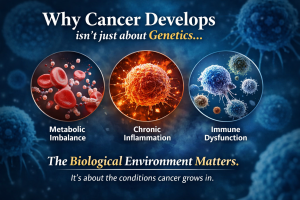
Cancer is often described as a genetic disease—something that develops due to mutations within cells. While genetics certainly play a role, this explanation alone does not fully account for why cancer develops, progresses, or behaves differently from one individual to another. It may be the Metabolic Terrain.
Many patients ask:
These are important questions—and they point toward a broader understanding of cancer that extends beyond genetics alone.
At SIE Medical, we approach cancer through a metabolic and systems-based framework, focusing on the internal environment in which cancer develops.
Rather than viewing cancer as an isolated event, it can be helpful to understand it as the result of long-standing biological imbalances and process that are not working as they should.
These may include:
Over time, these factors can create conditions that allow abnormal cells not only to develop—but to persist and grow.
👉 This shifts the question from:
“Where is the tumor?”
To:
“What in the body allowed this process to take hold or destroy the cancer cells normally?”
Every cell in the body relies on energy to function properly. Healthy cells primarily generate energy efficiently through oxygen-dependent pathways.
Cancer cells, however, often rely on altered metabolic processes that allow them to:
This metabolic shift is not just a feature of cancer—it may be a central driver of how cancer behaves.
Additionally, systemic factors such as:
can influence the environment in which cancer cells exist.
Inflammation is a normal part of the body’s defense system. However, when it becomes chronic, it can contribute to:
Over time, this environment may support the development and progression of disease, including cancer.
Many patients are never evaluated for:
The immune system plays a critical role in identifying and eliminating abnormal cells.
When immune function is compromised or dysregulated:
Factors that influence immune function include:
Certain cancers are influenced by hormonal signaling and environmental exposures.
These may include:
Understanding these influences can provide additional insight into the broader picture of disease development.
For many patients, cancer care focuses primarily on removing or reducing the tumor burden.
While this is essential, it may not fully address:
A metabolic and systems-based perspective allows for a more comprehensive understanding of these elements.
Understanding the potential drivers of cancer is not about assigning cause—it is about identifying modifiable factors that may influence outcomes.
This may include:
These considerations are not a replacement for conventional oncology care—but may serve as a complementary layer of support.
This metabolic perspective forms the foundation of an integrative oncology approach.
By evaluating the broader biological environment, it becomes possible to:
👉 This is where a more comprehensive, systems-based approach can be valuable.
You may benefit from a more comprehensive approach if you:
At SIE Medical, we focus on identifying and addressing the underlying biological factors that may influence complex conditions, including cancer.
Our approach includes:
If you are seeking a more comprehensive understanding of your condition or want to explore how a metabolic approach may support your care, a consultation may provide additional clarity.
You can request a consultation to determine whether this approach is appropriate for your situation.