


What Is Integrative Medicine?
Quick Answer: Integrative medicine is a patient-centered approach that combines conventional Western medicine with evidence-informed complementary methods, including naturopathic care, environmental medicine, nutritional therapy, and functional testing. The goal is not to replace standard medical care but to look more completely at what is driving a patient's symptoms and health patterns. Rather than treating a diagnosis in isolation, integrative medicine asks what is sustaining it.
At SIE Medical, Dr. Kimberly Williford, NMD, MS, RD/LD, practices this model across clinics in Atlanta and Austin. The framework she uses draws on multiple disciplines and applies them through a single, unified clinical lens for each patient.
How Is Integrative Medicine Different From Conventional Care?
Quick Answer: Conventional care is built around diagnosing and treating specific diseases, often after they develop. Integrative medicine uses those same diagnostic tools but extends the evaluation to include gut health, hormones, mitochondrial function, environmental exposures, nutrient status, inflammatory load, and the patterns connecting symptoms across body systems. The difference is not rejection of conventional medicine. It is a deeper layer of clinical questioning applied alongside it.
Standard medicine is essential. Lab panels, imaging, medications, and specialist referrals remain part of integrative care. What changes is the scope of the evaluation. A patient with persistent fatigue, for example, may receive a normal thyroid panel and be told nothing is wrong. An integrative evaluation looks further: thyroid antibodies, Free T3 and T4 conversion, gut microbiome, cortisol patterns, nutrient levels, mitochondrial energy production, and inflammatory markers. The diagnosis is the starting point, not the full story.
What Does Integrative Medicine Actually Look At?
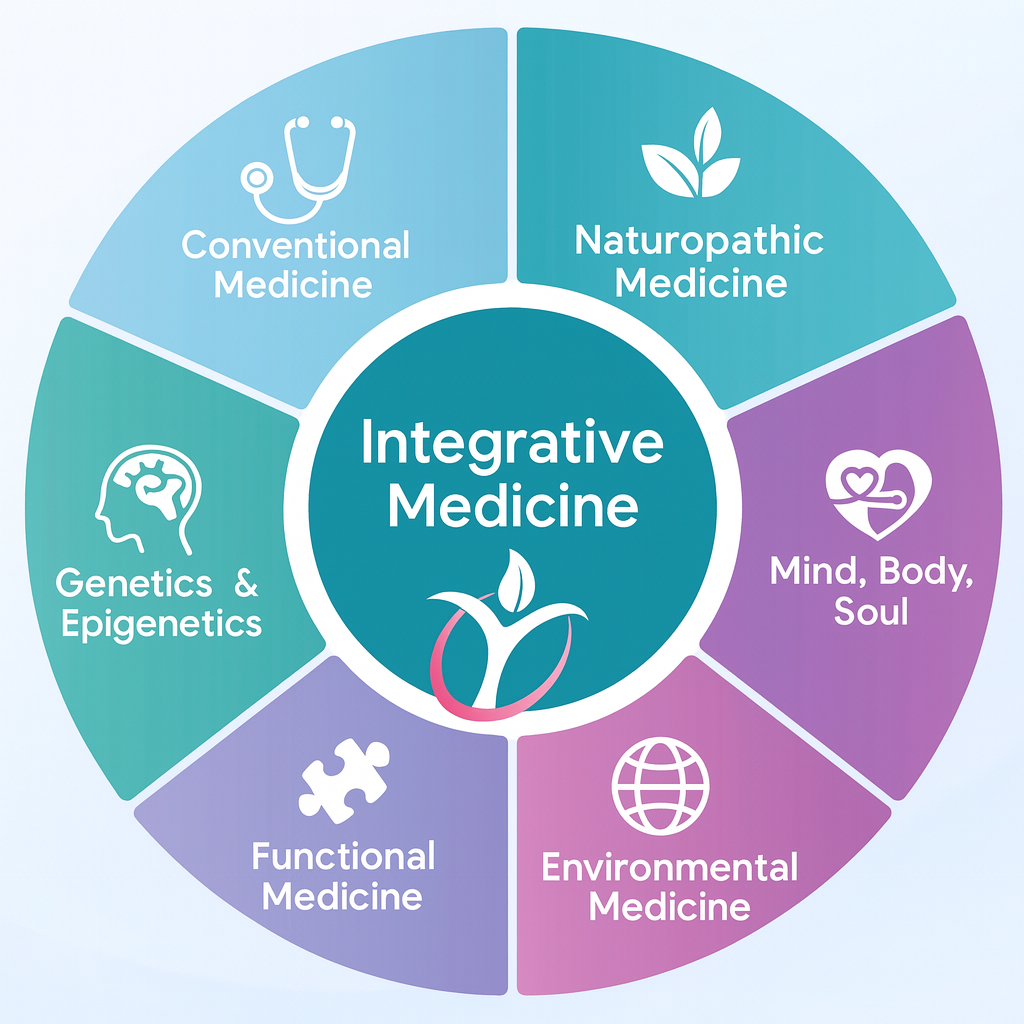
The clinical frame at SIE Medical draws on six interconnected areas of evaluation. These are not separate departments. They are lenses applied together when building a complete picture of a patient's health.
1. Conventional Medicine
Diagnostic tools, laboratory testing, imaging, and medications remain foundational. Integrative physicians use evidence-based conventional medicine as the baseline, not as a ceiling. Where conventional care stops at the diagnosis, integrative care continues the investigation.
2. Naturopathic Medicine
Naturopathic medicine emphasizes the body's capacity to regulate and recover when given the right conditions. At SIE Medical, this means evaluating metabolic function, nutrition, botanical medicine when appropriate, and the physiological context that either supports or undermines recovery. Dr. Williford holds a doctorate in naturopathic medicine and brings this lens to every patient evaluation. For patients in Atlanta and Austin seeking a naturopathic approach, this framing is central to the SIE model.
3. Environmental Medicine
Environmental medicine examines how external exposures, including mold, mycotoxins, heavy metals, chemicals, pesticides, and air quality, affect long-term health and chronic disease patterns. Dr. Williford holds a fellowship in Environmental Medicine and is a member of the American Academy of Environmental Medicine (AAEM). This makes SIE Medical unusual among integrative practices: the environmental layer is not an afterthought. It is a full clinical discipline applied when exposure history warrants it. Patients in Austin particularly benefit from this lens given Central Texas mold and environmental load patterns. Learn more at the Environmental Medicine hub.
4. Functional Medicine
Functional medicine looks at the biological mechanisms driving disease rather than just the disease label itself. Advanced testing such as gut microbiome analysis, metabolic profiling, comprehensive hormone panels, and inflammatory markers reveals patterns that standard panels frequently miss. Functional medicine at SIE is a method within the broader integrative model, not a standalone brand.
5. Mitochondrial and Metabolic Health
Mitochondria are the energy-producing structures inside cells. When they are compromised, the downstream effects include fatigue that does not improve with rest, cognitive difficulty, poor recovery, and impaired immune regulation. Metabolic dysfunction, including insulin resistance, blood sugar instability, and disrupted fat metabolism, often underlies symptoms that appear unrelated. At SIE Medical, metabolic and mitochondrial health evaluation is a core part of the integrative workup for patients with chronic fatigue, autoimmune conditions, and complex presentations.
6. Genetics and Epigenetics
Genetic predispositions and epigenetic influences, how lifestyle, environment, and diet affect gene expression, shape why two patients with the same diagnosis can present and respond very differently. SIE Medical uses this information to personalize care, particularly in areas like detoxification capacity, nutrient metabolism, and inflammation regulation.
What Conditions Does Integrative Medicine Address?
Quick Answer: Integrative medicine is used for a wide range of chronic and complex conditions where conventional diagnosis alone has not provided satisfying answers. The most common at SIE Medical include autoimmune conditions (Hashimoto's, lupus, rheumatoid arthritis, Graves', celiac), integrative oncology support, gut and digestive dysfunction, hormone imbalances, fatigue and mitochondrial issues, environmental illness and mold-related conditions, and metabolic health concerns.
Patients often arrive after being told their labs are normal despite persistent symptoms. The integrative frame is particularly useful in those situations because it asks questions that standard screening does not. Key areas at SIE Medical:
- Autoimmune conditions: Hashimoto's thyroiditis, lupus, rheumatoid arthritis, Graves' disease, celiac, and related conditions evaluated through a terrain and gut-immune lens
- Integrative oncology: Whole-person support during and after conventional cancer treatment, working alongside the oncology team. See the integrative oncology hub
- Digestive health: SIBO, leaky gut, IBS, inflammatory bowel, motility issues, food sensitivities, and how gut function connects to hormones, blood sugar, and inflammation
- Hormone health: Thyroid dysfunction beyond standard panels, adrenal patterns, sex hormone imbalances, perimenopause
- Environmental illness: Mold and mycotoxin exposure, chemical sensitivities, heavy metal burden, PFAS and related toxicants
- Chronic fatigue and brain fog: Mitochondrial, metabolic, immune, and environmental contributors evaluated together
- Metabolic health: Blood sugar dysregulation, weight changes despite dietary effort, cardiometabolic risk
What Does an Integrative Evaluation at SIE Medical Look Like?
An initial consultation at SIE Medical is a thorough clinical visit, not a wellness coaching session. Dr. Williford reviews medical history in full, including past diagnoses, medications, supplements, environmental exposures, family history, and symptom patterns over time.
From there, she recommends targeted testing based on what the clinical picture suggests. That might include advanced thyroid panels, gut microbiome evaluation, comprehensive hormone testing, metabolic and mitochondrial markers, nutrient levels, inflammatory markers, or environmental exposure assessment when warranted.
The result is a care plan specific to that patient's physiology and situation, not a protocol applied by condition name.
Why Patients Choose SIE Medical for Integrative Care
Patients in Atlanta, Austin, and via telehealth typically arrive for one of a few reasons: they have been told everything looks normal and still feel unwell; they are navigating a chronic condition and want a more complete picture than they are getting; or they are cancer patients who want whole-person support alongside their oncology care.
What distinguishes SIE Medical is the combination of a licensed integrative physician with formal naturopathic, nutritional, and environmental medicine training, applied through a rigorous clinical process rather than a general wellness model.
Atlanta office: 3193 Howell Mill Rd NW, Suite 306, Atlanta, GA 30327 | (404) 236-6234
Austin office: 3315 Ranch Rd. S. 620, Suite 100, Austin, TX 78738 | (512) 788-9941
Serenbe: 11090 Serenbe Lane, Suite 240, Chattahoochee Hills, GA 30268
Working With SIE Medical
If your symptoms have not been fully explained by standard care, or if you are looking for a physician who can evaluate the full picture across gut, hormones, environment, metabolism, and immune function, a Discovery consultation at SIE Medical may be a useful starting point.
You are welcome to reach out through the contact page at your own pace. There is no obligation, and the conversation begins wherever your questions are.