
01
Prevention & Longevity
Understand current health, preserve function, and reduce avoidable risk.
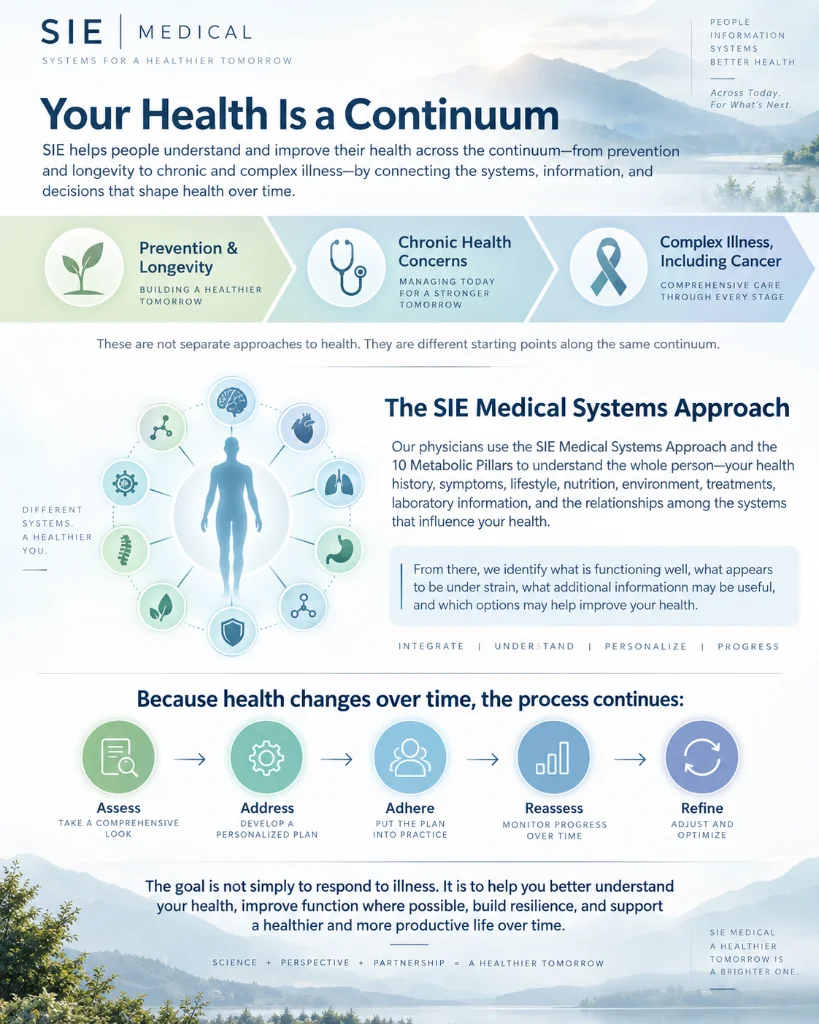
SIE helps people understand and improve their health across the continuum—from prevention and longevity to chronic and complex illness—by connecting the systems, information, and decisions that shape health over time.
You may want to stay healthy and reduce future risk. You may already be experiencing metabolic, digestive, hormonal, immune, environmental, or other chronic health concerns. Or you may be facing a complex diagnosis such as cancer and want a more comprehensive approach alongside conventional medical care.
These are different starting points along the same health continuum.
Age, genetics, nutrition, activity, sleep, stress, environmental exposures, medical treatment, illness, and recovery can all influence health. A person may feel well while early areas of strain are developing—or may be managing several concerns that affect one another.
Understand current health, preserve function, and reduce avoidable risk.
Recognize early patterns or changes before they become more disruptive.
Investigate persistent symptoms and the systems that may be contributing.
Bring diagnoses, treatments, symptoms, and whole-person health into one view.
Support function, recovery capacity, quality of life, and adaptation.
Monitor progress, reassess priorities, and refine the plan over time.
You can enter the continuum at any point. SIE Medical begins with where you are today. People may move between stages as their health, treatment, priorities, and circumstances change.
The starting point may be different, but the purpose is the same: understand the whole person, identify meaningful priorities, and develop an individualized path forward.
For people focused on prevention, healthspan, and longevity, care may begin by establishing a clearer baseline and identifying areas that deserve attention before they become more significant.
For people with emerging or persistent concerns, the focus is on understanding patterns across systems and identifying practical priorities for improving health and function where possible.
For people navigating cancer, cognitive decline, environmental illness, or another complex chronic condition, care may need to account for several diagnoses, treatments, symptoms, exposures, and goals at the same time.
Our physicians use the SIE Medical Systems Approach and the 10 Metabolic Pillars to consider your health history, symptoms, diagnoses, lifestyle, nutrition, environment, treatments, medications, supplements, laboratory information, imaging, and the relationships among the systems that influence your health.
The purpose is to identify what is functioning well, what appears to be under strain, which contributors may be relevant, what information is still missing, and what should be prioritized now. A diagnosis remains important, but it is considered within the larger context of the person living with it.
Learn about integrative medicine →The pillars give the care team a consistent way to organize information and examine relationships across the body. They are an assessment framework—not a fixed protocol. Not every patient needs testing or intervention in every area.
Glucose regulation, insulin patterns, energy stability, and metabolic signaling.
Relevant exposures and the body’s capacity to process and eliminate them.
Digestion, gut ecology, and relationships with immune and metabolic function.
Inflammatory regulation and cellular responses to internal and external stressors.
Delivery of blood, oxygen, and nutrients throughout the body.
Immune defense, tolerance, regulation, and recovery.
Stress response, sleep, circadian rhythms, and daily recovery patterns.
Endocrine signaling that influences metabolism, energy, mood, sleep, and function.
Cognitive and emotional health and their relationship to physical function.
How nutrition, lifestyle, and environment may influence gene expression over time.
Health changes, so a useful plan must be able to change with it. SIE Medical uses an ongoing care cycle to connect assessment, action, follow-through, and new information.
The cycle repeats as needed. The goal is a plan that remains relevant rather than a set of recommendations that never changes.
Request a Discovery Call →The exact evaluation and plan depend on the person. When appropriate, care may include the following elements.
Health history, symptoms, diagnoses, previous treatment, medications, supplements, and personal goals.
Review of relevant laboratory results, imaging, treatment history, and medical records.
Conventional or specialized testing when it can help answer a useful clinical question.
Individualized nutrition, lifestyle, sleep, stress, movement, and environmental recommendations.
Consideration of current therapies and supportive options organized around clear priorities.
Follow-up, monitoring, reassessment, and coordination with appropriate conventional or specialty care.
The process begins before the first physician visit so your care team can understand your health over time—not only the symptoms of the day.
A 15- to 20-minute call with an SIE Medical Health Advocate to understand why you are reaching out, answer initial questions, and determine whether the practice may be a good fit. There is no obligation to book.
Complete health-history forms and provide relevant laboratory results, imaging, medical records, and a current list of medications and supplements.
Your physician reviews the information, explores relationships among relevant systems, identifies priorities, and discusses whether additional testing or next steps may be useful.
Your individualized Plan of Health brings together findings, priorities, recommendations, and follow-up. Later visits review new information, assess response, and refine the plan.
Including cancer, Alzheimer’s or cognitive concerns, and environmental illness.
The physician still completes a comprehensive, whole-person initial evaluation.
No. Some patients begin with prevention, longevity, or a desire to understand their current health more clearly. Others begin because symptoms, a diagnosis, or treatment have made a more comprehensive evaluation important.
No. Testing and recommendations are based on the person’s history, current concerns, existing information, clinical questions, and goals. The 10 Metabolic Pillars organize the evaluation; they do not require the same protocol for everyone.
Yes. Integrative and complex care can complement primary, oncology, and specialty care. SIE Medical does not replace emergency care or the conventional physicians responsible for diagnosis and treatment in their areas of practice.
That is why reassessment is built into the model. New symptoms, laboratory information, treatment changes, progress, and changing goals can all affect the next priorities.
SIE Medical offers in-office care in Atlanta and Austin, with telehealth options for eligible patients. The best format depends on clinical needs, location, and applicable requirements.
The goal is not simply to respond to illness. It is to help you understand your health more clearly, improve function where possible, build resilience, and make informed decisions over time.
Whether you are focused on prevention, working through persistent concerns, navigating complex illness, or rebuilding after treatment, SIE Medical begins with your current health and the next questions that matter most.
This page is educational and does not provide medical diagnosis or treatment. Always consult the appropriate licensed physician or healthcare professional for diagnosis, treatment, urgent concerns, or changes to your current care.