

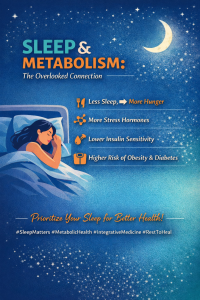
Sleep is a fundamental biological process essential for hormonal balance, glucose regulation, and metabolic health. While nutrition and physical activity are routinely emphasized in preventive medicine, sleep duration and sleep quality remain underrecognized determinants of metabolic disease risk.
A growing body of epidemiological and experimental research demonstrates that insufficient sleep contributes directly to hormonal disruption, impaired insulin sensitivity, increased appetite, and higher risk of obesity and type 2 diabetes. From an integrative and functional medicine perspective, sleep should be regarded as a core pillar of metabolic health, equivalent in importance to diet, movement, and stress regulation.
This article reviews the current evidence linking sleep loss to metabolic dysfunction and discusses its implications for clinical practice.
Sleep is a highly organized physiological state governed by circadian rhythms and sleep–wake homeostasis. During sleep, coordinated hormonal release supports tissue repair, energy balance, immune function, and nervous system regulation.
Several key hormones are tightly linked to sleep:
Leptin, which signals satiety
Ghrelin, which stimulates hunger
Cortisol, the primary stress hormone
Growth hormone, essential for repair and metabolic regulation
Insulin, which controls glucose uptake
Disruption of sleep alters the normal secretion patterns of these hormones, producing downstream metabolic consequences.
Average sleep duration has declined steadily over recent decades. Most adults now report sleeping fewer than the recommended 7–9 hours per night, while sleep deprivation is increasingly common among children and adolescents.
This reduction in sleep duration parallels the rising prevalence of obesity, insulin resistance, metabolic syndrome, and cardiovascular disease. Large-scale observational studies consistently demonstrate an association between short sleep duration and increased body mass index, independent of physical activity and caloric intake.
Sleep plays a central role in appetite control through its effects on leptin and ghrelin:
Adequate sleep supports normal leptin signaling and appetite suppression
Sleep deprivation lowers leptin levels and increases ghrelin secretion
Clinical studies show that sleep-restricted individuals experience:
Increased hunger
Heightened cravings for carbohydrates and energy-dense foods
Reduced satiety after meals
These changes are hormonally driven and occur even in the absence of intentional dietary changes.
Cortisol follows a circadian rhythm, peaking in the early morning and declining in the evening. Sleep deprivation disrupts this pattern, resulting in elevated evening cortisol levels and prolonged activation of the stress response.
Chronic elevations in cortisol contribute to:
Visceral fat accumulation
Insulin resistance
Inflammatory signaling
Impaired glucose metabolism
From an integrative standpoint, inadequate sleep represents a form of chronic physiological stress.
Growth hormone secretion occurs primarily during deep, slow-wave sleep. This hormone is critical for:
Muscle maintenance
Fat metabolism
Cellular repair
Tissue regeneration
Reduced sleep duration or poor sleep quality leads to diminished growth hormone release, impairing metabolic repair processes and contributing to unfavorable body composition changes.
Experimental sleep restriction studies provide strong evidence that inadequate sleep directly impairs glucose regulation.
Findings include:
Reduced insulin sensitivity
Impaired glucose tolerance
Elevated postprandial blood glucose levels
Notably, these metabolic changes have been observed after just a few nights of sleep restriction in healthy individuals, demonstrating a causal relationship between sleep loss and metabolic dysfunction.
Numerous population-based studies show that individuals who sleep fewer than six hours per night are at significantly increased risk for:
Overweight and obesity
Metabolic syndrome
Type 2 diabetes
This association is observed across age groups, including children, suggesting early-life sleep patterns may influence long-term metabolic outcomes.
Controlled laboratory studies eliminate confounding variables and confirm that sleep loss itself produces metabolic changes.
Sleep-restricted participants demonstrate:
Increased caloric intake
Altered appetite hormone levels
Reduced insulin sensitivity
Elevated cortisol levels
These findings establish that sleep deprivation is not merely associated with metabolic disease but actively contributes to its development.
In clinical practice, metabolic disorders are often addressed through dietary modification and exercise alone. However, the evidence indicates that sleep deprivation can undermine these interventions by altering hormonal and metabolic pathways.
From an integrative perspective:
Optimizing sleep may enhance insulin sensitivity
Appetite regulation improves with adequate sleep
Weight management efforts are more effective when sleep is sufficient
Sleep optimization should therefore be considered a foundational therapeutic strategy in the prevention and management of metabolic disease.
Sleep interventions are:
Low-cost
Low-risk
High-impact
Addressing sleep duration and quality has the potential to improve metabolic health outcomes at both the individual and population levels. Recognizing sleep as an essential component of preventive care may help reduce the burden of obesity and diabetes.
Sleep is a central regulator of hormonal balance and metabolic function. Chronic sleep deprivation disrupts appetite hormones, increases stress physiology, impairs glucose metabolism, and promotes weight gain.
For patients with obesity, insulin resistance, fatigue, or hormonal imbalance, sleep assessment and optimization should be a primary consideration, not an afterthought.
Healing and metabolic regulation depend on adequate, restorative sleep.
Q: How does sleep affect metabolism?
A: Sleep regulates hormones that control appetite, stress, insulin sensitivity, and glucose metabolism. Inadequate sleep disrupts these hormones, increasing the risk of weight gain and metabolic disease.
Q: Can lack of sleep cause weight gain?
A: Yes. Sleep deprivation lowers leptin, raises ghrelin, increases hunger, and reduces insulin sensitivity, all of which promote weight gain.
Q: How much sleep is needed for metabolic health?
A: Most adults require 7–9 hours of sleep per night to support optimal hormonal balance and metabolic function.
Q: Does sleep deprivation affect blood sugar levels?
A: Yes. Even short-term sleep restriction can impair glucose tolerance and reduce insulin sensitivity, increasing diabetes risk.
Q: Is sleep more important than diet or exercise for weight loss?
A: Sleep is equally important. Poor sleep can undermine the benefits of healthy eating and exercise by disrupting hormonal regulation.
Q: Can improving sleep reverse insulin resistance?
A: Improving sleep duration and quality can significantly improve insulin sensitivity and metabolic markers, particularly when combined with other lifestyle interventions.
Q: Why is sleep considered a pillar of integrative medicine?
A: Integrative medicine emphasizes addressing root causes. Sleep directly influences hormonal regulation, stress physiology, and metabolic health, making it foundational to healing.